model_creation_date 1877
model_size 11 x 8
model_weight 475g
model_catalognum II 3b
model_objectnum 97687-000
model_originalprize 9,50
model_since 02.12.1960.

model_since 02.12.1960.
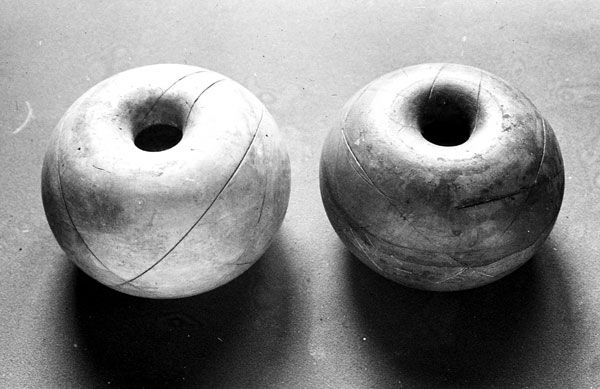
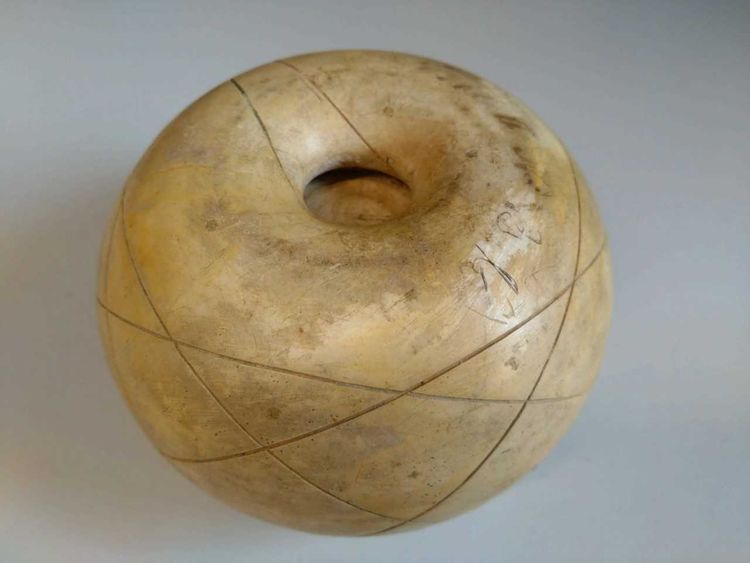
Surface of revolution of constant mean curvature
Surfaces of constant mean curvature are defined by the fact that the sum of the reciprocals of their two principal radii of curvature has the same numerical value at every point. The partial differential equation by which they are defined becomes an integrable total if one restricts oneself to surfaces of revolution. For the meridian curve, one obtains the equation z = \int \frac{r^2 \pm a_1 a_2}{\sqrt{({a_1}^2-r^2) (r^2-{a_2}^2)}} dr. According to Delaunay, the meridian curve of these surfaces is also the curve described by the focus of a conic section when it rolls along a straight line, which then becomes the axis of rotation. Corresponding to the three conic sections ellipse, hyperbola, parabola, one obtains three different types, which Plateau named onduloid, nodoid, catenoid in his work "Statique experimental et theorique des liquides".
According to Laplace, the equilibrium figures of fluids free from the influence of gravity are bounded by surfaces of constant mean curvature. Geometrically, they can also be defined as certain parallel surfaces to surfaces of constant positive curvature. A special case of this are minimal surfaces, whose mean curvature is zero. These have the property of possessing a smaller area than any other adjacent surface that is passed through any closed boundary curve on it. Mechanically, they are the surfaces assumed by the liquid skin clamped between a given boundary curve (e.g., by immersing a wire of the shape of the curve in soap solution).
Minimal surfaces are divided into infinitely small squares by both their curvature and their asymptote curves. (The indicatrix for these surfaces is an equilateral hyperbola, which is why the asymptote curves are perpendicular to each other.) For each minimal surface, there is a second, so-called Bonnet bending surface, which can be developed onto it in such a way that the curvature lines of one merge into the asymptote curves of the other.
The behavior of the geodesic lines of surfaces of revolution of constant mean curvature varies depending on the angle at which one meets the largest parallel circle. Either it moves between two parallel circles (blue), or it asymptotically approaches the throat circle, i.e., the parallel circle of the smallest radius (green), or it extends over the entire surface.
The meridian curve results in the model for a_1 = 1 cm, a_2 = 5.77 cm from the equation given above, if the lower (negative) sign is chosen from the two signs occurring there.