model_size 24 x 24 x 24,5
model_weight 420
model_catalognum 400/105
model_objectnum 97581-000
model_originalprize 89,20
model_since 24.04.1958.

model_since 24.04.1958.
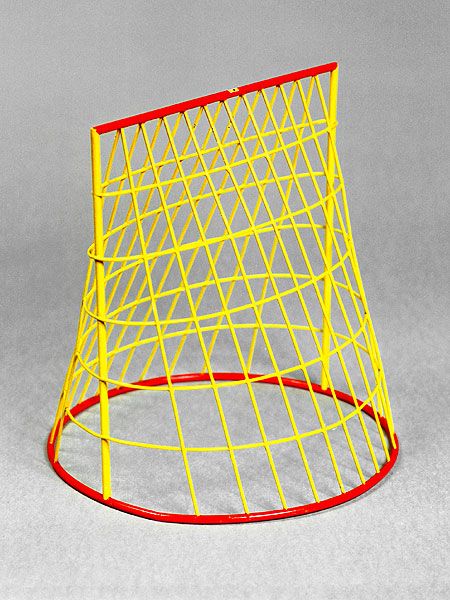
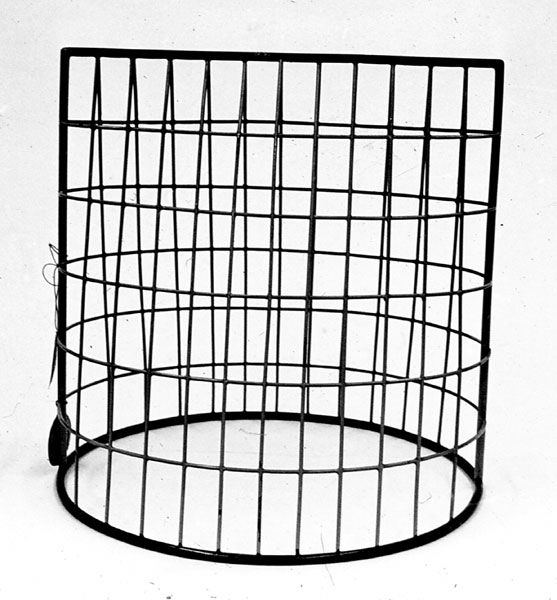
The model represents a special right conoid, which is the locus of a line perpendicular to a fixed line, called the axis, and intersects the circumference of a circle whose axis intersects this fixed line at a right angle. The generating lines of the conoid are to be seen, further its intersection with planes parallel to the plane of the circle.
Given are a cicle k and a line g, that intersects the circle axis (both red).The generatrix of the conoid are lines, that are perpendicular to g, that interest k as well as g. The model next to this generatix also contains an intersection curve with support planes (ellipses), which are parallel to the circle plane. It is a family of of projective cone section, that distinguishes all conoids of the fourth order. The thicker generatrixes are "Torsallinien", which means lines with a light curvature. Those intersect the directrix in the " cuspidal points". Two other (cylindrical) torsal lines are in the directrix, that is normal to the symmetry plane of the conoid. "
With a skillful setup the outlines of the model, under normal projection onto the three with each other orthogonal image planes, square, triangle and circle.
In general skew ruled surfaces can be determined by three directrices. If one directrix is a line, the ruled surface is called family of surfaces. If two directrices are straight, a net surfaceis obtained. Each net surface is in a double sense a family of surfaces. If there are three straight directrices, there is a regulus present. Each regulus of the second order is overlaid by a multitude of generatrices. If a generating line (directrix) is a distant line, the regulus is called hyperbolic paraboloid, if not hyperboloid of one sheet.
If the generating lines of a plane (directrix plane) are parallel, the ruled surface is called conoidal surface. In that case the distant line of the directrix plane acts as a directrix. Because of that, each conoidal surface is a special family of surfaces. If the ruled surface contains another directrix, it is called conoid, in particular straight conoid, if the second directrix is normal to the directrix plane - like in this case. Each conoid is therefore a special net surface.