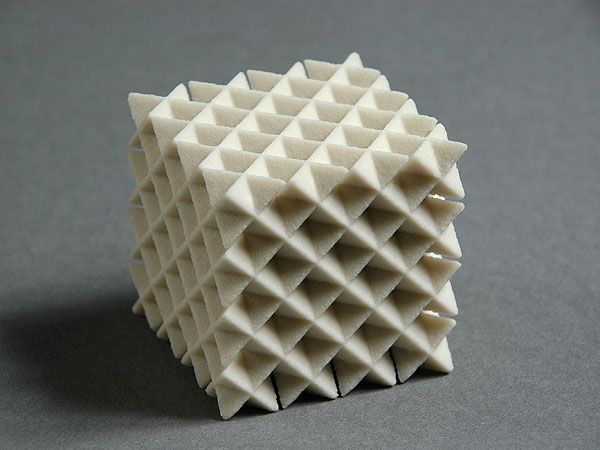
model_creation_date 2004
model_size je 5,3 x 5,3 x 5,3
model_weight 53, 79, 98, 129

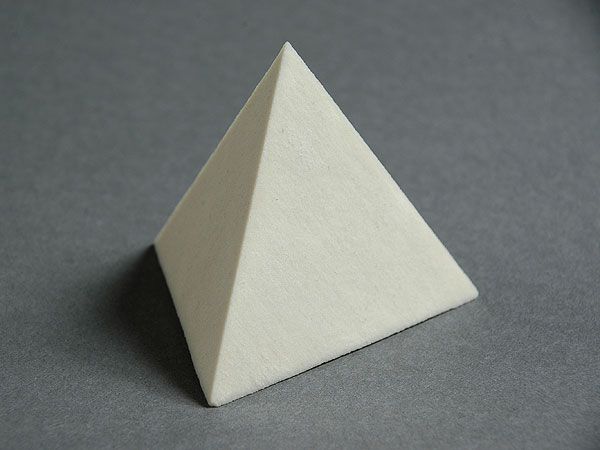
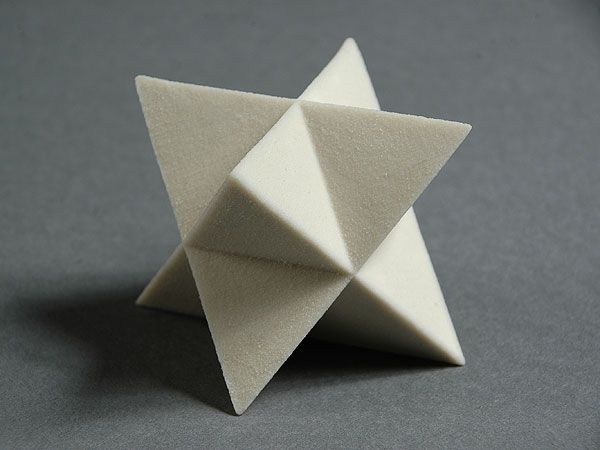
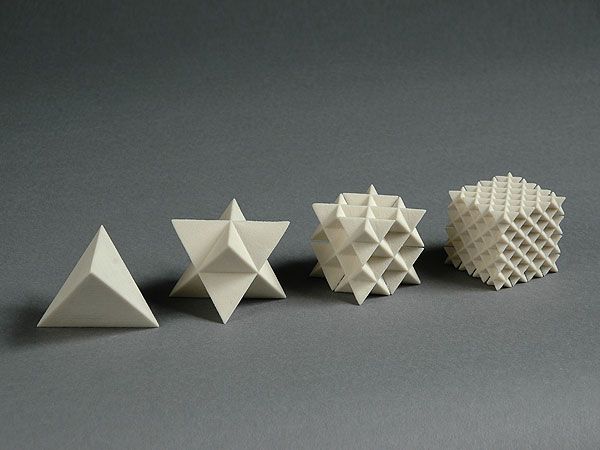
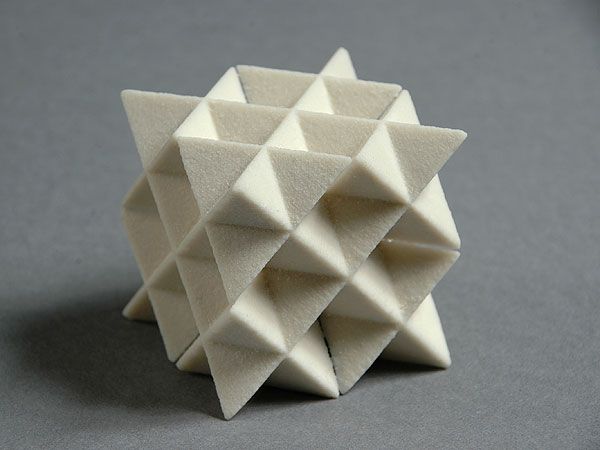
The tetrahedron fractal is a surface fractal and can be considered an analogue of the Koch curve. The four facets of the regular tetrahedron are each divided into four equilateral triangles. New (smaller) tetrahedra are constructed over the middle triangles, and the bases are removed. This process is repeated continuously with all new facets. In the first iteration, the "stella octangula" is created. The eight vertices of the stella octangula are the corners of a boundary cube, whose volume is filled by the tetrahedron fractal.
The area of the tetrahedral fractal is infinite. The T-fractal encloses a point set with volume V = \frac{1}{4}a^{3}\sqrt{2}. Where $a$ is the edge length of the starting tetrahedron. This is consistent with the observation that the T-fractal has a boundary cube. The dimension of the T-fractal is d = 1+\frac{\ln{3}}{\ln{2}} \approx 2.5849.