model_creation_date 1989
model_size 33 x 33 x 27
model_since 1995.

model_since 1995.
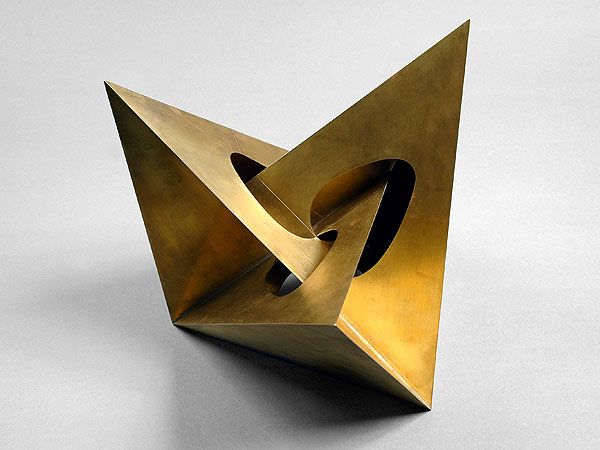
The models version 1-3 show three (combinatorially) different polyhedral models of the Boy surface with 9 vertices, (which is smallest possible) and only 10 faces. A polyhedral model of the Boy surface is a polyhedral surface without self-intersections in the neighborhood of vertices which is homeomorphic to the real projective plane. Such a surface must have (generically) a triple point (for topological reasons). This implies that it must have at least 9 vertices. The models have a symmetry axis of order 3 (like the original Boy surface). In version 1 three of the faces are parallelograms and three are nonconvex quadrangles. In versions 2 and 3 three of the faces are nonconvex pentagons which together form a symmetric Möbius strip. The selfintersection figure in each of the models is a nonplanar hexagon with self-intersections (3 edges meeting in the triple point). In the models in some of the faces are cut "windows" (to avoid material self-itersections and to improve visibility of the essential features).