model_creation_date 1999
model_size 42 x 10 x 25
model_weight 250
model_since 2001.

model_since 2001.
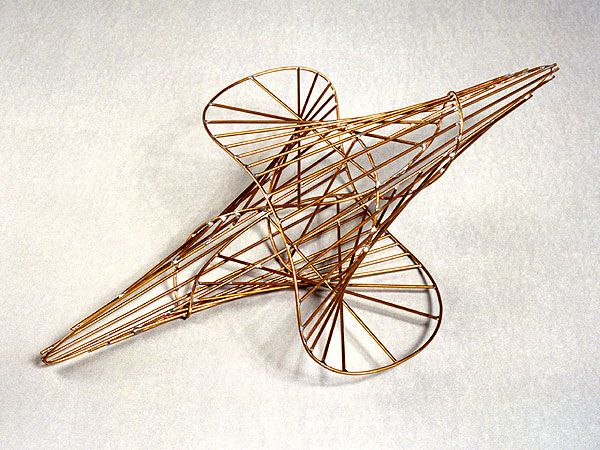
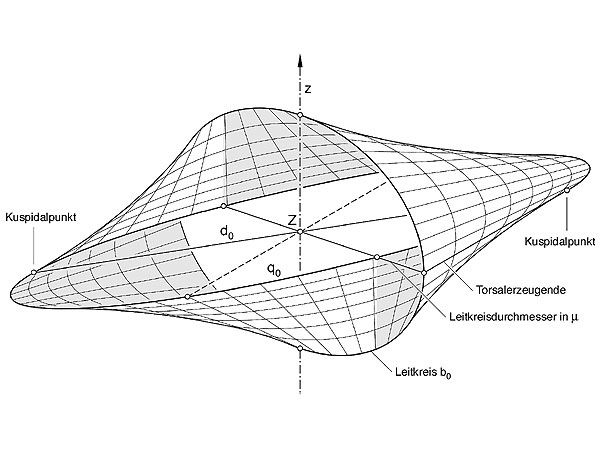
The model shows a conoidal ruled surface with a circle and another ellipse as directrixes. Because the conics are projectively coupled, the fourth-degree ruled surface is of the fifth Sturm type. The surface is bounded by a twisted curve and supports another curve. On each generator, the directrix bisects the distance between the curve points. The curve is the boundary of a circular shear surface.
If one examines the self-shadow boundary of a circular shear surface under parallel illumination, one sees that, in general, each generating circle of the "circular shear surface has two points on the self-shadow boundary. These points always lie on a diameter of the corresponding circle. The diameter lines of a family of shear circles through the self-shadow boundary therefore satisfy a ruled surface. This so-called companion ruled surface of the self-shadow boundary of the circular shear surface is shown here. Under special assumptions, the companion ruled surface can be simplified considerably. An "example of this can be seen in the model collection.