model_creation_date 1998
model_size 20 x 30 x 16,5
model_weight 200
model_since 2001.

model_since 2001.
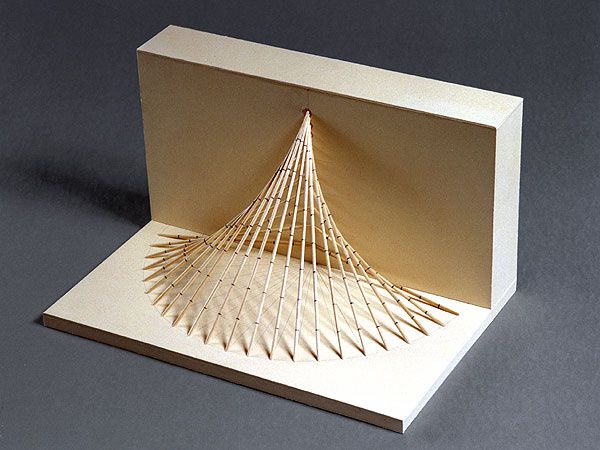
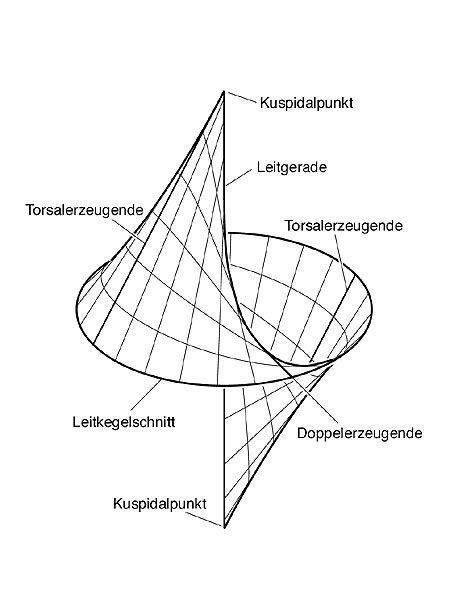
The model shows an oblique conoid with a circle as the directrix and its axis as the directrix. The directrix plane is inclined at 45 degrees to the circular plane. The surface is a lattice surface of the fourth degree and the seventh Sturm kind. The black markings on the generators indicate examples from the family of projective conic sections. It is noteworthy that the conic sections (ellipses) map onto confocal circles when projected perpendicularly onto the directrix plane (see drawing).
If one examines the boundary of the self-shadow of a torus (circular ring surface), one can consider the surface normals along the boundary of the self-shadow as the generators of a so-called companion ruled surface. In this case, the directrix of the companion ruled surface is the center circle of the torus, and the axis of rotation is the directrix. The companion ruled surface can therefore be obtained by intersecting the normal congruence of the torus with the planar complex of the normals of the light direction. The result is the present ruled surface, whose shape varies depending on the direction of the light with regard to its directional plane. The surface can degenerate into a cylinder of revolution through the center circle and the meridian plane normal to the direction of the light (illumination from a distant point of the center circle plane) or coincide with the center circle plane (illumination parallel to the axis of rotation).