model_creation_date 1880
model_size 24 x 9
model_weight 1020
model_catalognum VI, 4, 360
model_objectnum 97672-000
model_originalprize 10,00
model_since 02.12.1960.

model_since 02.12.1960.
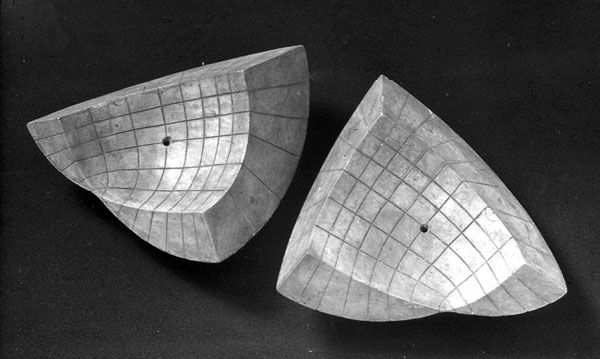
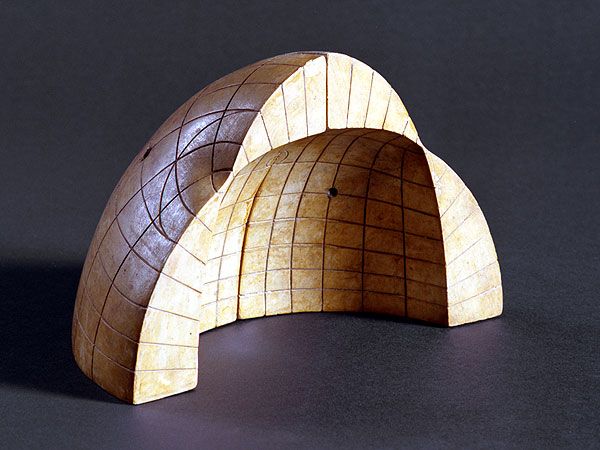
Topologically speaking, the Fresnel wave surface consists of two shells that touch each other at the four double points. In the model, the space between the inner and outer shells is filled with plaster. To view the inner shell, the surface was cut open and only a quarter of it is shown. This section can be divided into two octants along a principal section.
The surface has four real double tangent planes that touch the surface in circles. The circles are inscribed around the double points.
Augustin Fresnel (1788–1827) introduced this surface in connection with his investigations into crystal optics: It describes the wavefront of a light wave emanating from a point within an optically biaxial crystal. Hence the name Fresnel wave surface.
The scribed lines on each shell show a set of spherical and a set of ellipsoidal curves (i.e., intersection curves of the surface with concentric spheres or ellipsoids).
The directions of the rays are marked at the openings.